Author: Rebecca Last, Gardening at Last, Master Gardeners of Ottawa-Carleton; published with permission
A rose by any other name may smell sweet, but failing to document seeds that you have collected or purchased can lead to great frustration for gardeners.
Avoid Mystery Seeds!
For example, here is a bag of mystery seeds that emerged from a recent tidy-up. I’m pretty sure they were collected this year, but I have absolutely no idea what they are or where they came from.

Just naming seed packages is not enough. Here’s another example. This package was a gift from a fellow Master Gardener. The label tells me these seeds are sacred tobacco. However, there’s no date. I don’t know how old the seeds are, so I don’t know if they are viable.

Using Botanical Names
Knowing the common name is helpful, but not enough. There are two species of plant known as “sacred tobacco”: Nicotiana rustica and Nicotiana tabacum. The first has a high nicotine content and yellow flowers, while the second has pink flowers and is used to make cigarettes. More importantly, N. rustica seeds need light to germinate, while N. tabacum seeds do not. Knowing the scientific name of seeds helps to clarify mysteries such as this and ensure better success when starting seeds.
Now, what about cultivars? Every year, I grow a dozen or more varieties of heritage tomatoes. I need the labels to tell me more than Solanum lycopersicum and the date the seeds were collected. My garden is so small that I have to grow my tomato plants close together. Tomatoes don’t cross-pollinate much, but at such close quarters, mine won’t breed true, so I do not save their seeds. I buy my tomato seeds from local vendors. I put the year on the seed package at the time of purchase. Then I research each variety. Here is an example of a label I created.

The cultivar name is ‘Kangaroo Paw’. The tomato is yellow. It’s a determinate variety, so I can grow it in a pot, and it will mature in 75 to 90 days. Therefore, it requires a long growing season. In fact, I was picking these fruits into early October. The rest of the information on the label is optional, but I find the social history of heritage varieties fascinating. I have more success with some breeders’ products than with others.
Include Date of Maturity and Germinaton Period
The “date to maturity” information is important because it helps me understand what I can harvest and when from my garden. Knowing the germination period and protocols can be very helpful, too. I once obtained seeds for the lovely native plant, Actaea racemosa. These are expensive to buy, so I was keen to see if I could get plants from seed. I planned to start these seeds at the same time I was seeding my tomatoes and annual flowers. Then I read the following instructions:
“Indoors, surface sow onto moist, well-drained seed compost; do not cover seed but press gently into the soil. Ideal temperature: 22°C for 6 weeks, then cold stratify. Move to 4°C for 6–8 weeks, then return to warmth at 10° for germination.”
So, I was about three months late getting these started for the current growing season.
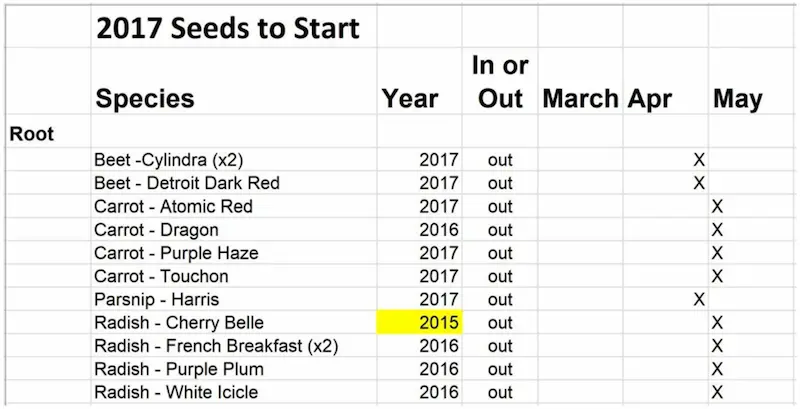
Knowing the germination period and days to maturity can help you create a planting table like this one, which I created a few years ago. The ‘Species column’ includes the cultivar name, while the ‘Year column’ tells me the age of the seeds. If I only had room for a few radishes, I would prioritize sowing the oldest seeds, Cherry Belle, which were two years old at this time. All my root vegetables were directly sown outside, either at the end of April or at the start of May. Plant schemes are especially helpful at mid- and end-season when we’re trying to fit in a second crop.
There’s lots more to know about documenting your seeds, but this will get you started on the fascinating journey of collecting seeds, saving them, and starting your own. Have fun!
About the Author
Comments

Gardening guidance for your area—and your garden
Join our newsletter for timely gardening guidance tailored to your area. Looking for a better value? Upgrade your newsletter for personalized plant-care guidance based on the plants growing in your garden.
Leave a Reply
You must be logged in to post a comment.