Sharp-lobed Hepatica is an Early Spring Bloomer
Photo:
reijotelaranta
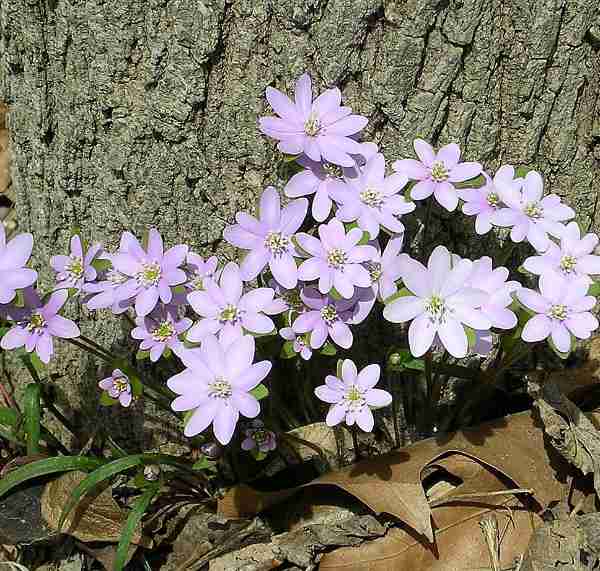
Hepaticas are among the first flowers to bloom in the spring. The flowers close at night and on cloudy days when pollinators are not likely to be flying. They are delicately attractive and have a tendency to blow about on their slender stems in the wind.
Heptica leaves are known as basal leaves, which means they only grow at the base of the plant. Its flower is symmetrical. The leaves turn red in winter and last until spring flowering.
Quick Growing Guide
Botanical Name: Hepatica acutiloba
En français: Hépatique á lobes aigus
Blooms:
Sun / Shade:
Water: Average water requirement.
Pollinators:
Care:
The two species of hepatica are sharp-lobed and round-lobed. Sharp-lobed refers to the leaves that are pointed on the ends. Round-lobed means they have more rounded tips. Bee visitors include honeybees, Small Carpenter bees, Andrenid bees, and Halictid bees.
Caring for Sharp-lobed Hepatica
In nature, find hepatica in dry, mixed forest. Hepetica is best grown in places where it can remain undisturbed for years. The plants will need a layer of decaying leaves as a year-round mulch.
Growing Hepatica in the garden in a location that simulates their natural environment of dry mixed forest. They require a location that has dappled sunlight in early spring and light shade during the summer.
Propagating Hepatica acutiloba
The hepatica seeds require a period of cold, moist, weather, followed by warm, moist weather, and then another period of cold and moist weather. Plant seeds in fall.
While Hepatica is slow to start, it is a very long-lived perennial and quite showy. Gardeners may also be attracted to this plant, as it is one of the first to bloom in springtime. They prefer to grow in woodlands, near slopes or banks, where the soil is moist in springtime. They are drought tolerant in the summer. Sometimes it is cultivated as a rock garden plant.
Companion Plants
Acer saccharum, Fraxinus americana, Dicentra canadensis, and Erigenia bulbosa are some suggested companion plants.
Pruning Hépatique á lobes aigus
The best way to propogate a heptica is through seeding or division. Do not remove the leaves over winter. Plant seeds in early fall.
Toxicity
Hepticas have poisonous leaves and hairy, toxic seeds to deter herbivores. They also partner with ants for seed dispersal. Ants take the seeds, eat the elaiosome and discard the seeds, usually in nutrient-rich soil that is hidden from seed-eating birds.
Other
No serious pest or disease issues.
The word “hepatica” comes from the Greek word “hepar” which means liver, and refers to the shape of the leaves. They also believed it would aid in liver ailments, hence the common names “liverwort” or “liverleaf.” Sharp-lobed hepaticas were used by the Chippewa in mammal traps and used by the Iroquois to relieve shortness of breath in forest runners. Modern medicine has proven that Heptica has no medical efficacy.
Comments

Gardening guidance for your area—and your garden
Join our newsletter for timely gardening guidance tailored to your area. Looking for a better value? Upgrade your newsletter for personalized plant-care guidance based on the plants growing in your garden.
Leave a Reply
You must be logged in to post a comment.