
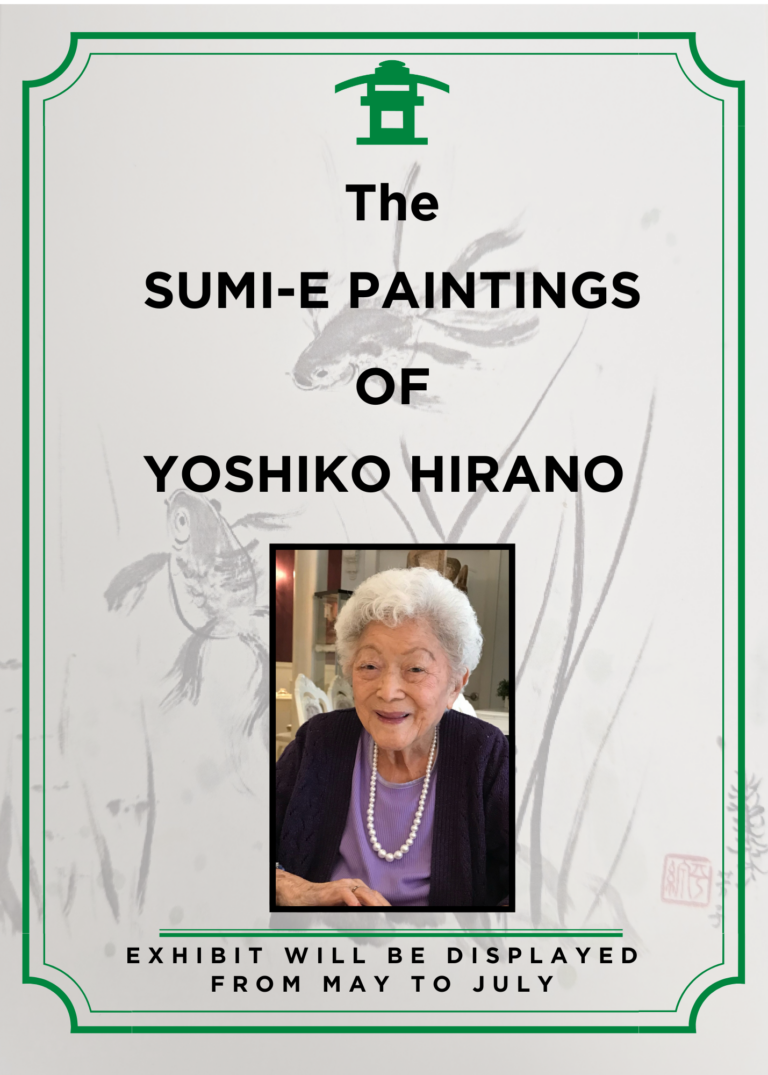
INTRODUCTION OF NIKKEI GALLERY DISPLAY – YOSHIKO HIRANO SUMI-E PAINTINGS
This art exhibition is a retrospective of the Sumi-e paintings of Yoshiko Hirano. She was a Nisei Canadian who was interned during World War II in interior BC. Post-war, she married, relocated to Toronto, and nurtured five children.
Later in life, she studied Sumi-e painting for six years at the Springbank Visual Arts Center in Mississauga. For the next twenty years, she pursued her passion for painting, channelling her life experiences into delicate yet powerful art.
Sumi-e, a traditional Japanese ink painting style, focuses on capturing the essence of a subject with minimal brushstrokes and subtle use of space.
The exhibition opens with her early work and transitions into her exploration of various genres, including birds, fish, and landscapes. Once she mastered the brush, her paintings became more expressive, using minimal and fluid brushwork to create images with feeling.
This is the art of a woman who lived a long and full life through good and bad then eventually had the opportunity to leave her personal visual legacy.
The exhibit is open from May 9 to the end of July and will be inside the Pavilion (weather permitting).
YOSHIKO THERESA HIRANO – THE ARTIST
Yoshiko (Maeda) Hirano was born February 14, 1920 in Port Moody, British Columbia. She passed away 103 years later while residing in Nikkei Home, Burnaby, BC.
In 1942, she, like all those of Japanese descent within 100 miles of the Pacific Coastline, was uprooted and sent to an internment camp in the interior of BC. She and her family (two brothers, a sister and parents) were relocated to Bay Farm, Slocan Lake, where sadly her dream of becoming a nurse dissolved, and instead she became a teacher in the camp. One of her students went on to become the successful architect Raymond Moriyama, who designed Nikkei Cultural Centre.
She married while in the internment camp, but once the war was over she and her husband made their way east, stopping for a time in Port Arthur, Ontario, where she gave birth to a daughter. They then moved further east, settling first in Toronto, then Mimico, where a second daughter and first son were born, then later to Port Credit (presently a part of Mississauga) where she had a third daughter and second son. All her children became successful professionals due to her amazing supportive parenting.
Once her children were established, she was able to find time to pursue her own pathway and interests in the early 1970’s. She first tried oil painting, which led her to sumi-e painting under the tutelage of F. Toyota. She worked through the six levels and earned her Han in 1984 at Springbank Visual Arts Centre in Mississauga.
Alone, she quietly continued to practice her painting, using many reference books and creating wonderful artwork – which became treasured gifts for family and friends. Later in life Yoshiko moved to Delta, BC, where she lived with her daughter and family. There, she found classes in Richmond, BC, which elevated her painting to amazing scenes of mountains, birds, squirrels, flowers and horses.
She shared her gift of painting with two granddaughters, who recall their Nana patiently teaching them the technique of sumi-e from how to grind the charcoal, load the brushes and then in a single stroke, paint from a dark-to-light gradient to produce the beginning of their artwork. They recall her teaching by example, then practicing over and over the brush strokes until they were able to generate their own art.
In 2010 she moved to Nikkei Home. Her body was beginning to fail her, so her practice of Sumi-e waned, but her creative spirit did not. She painted lovely hasty notes and bookmarks. Her mind was keen right up to her passing, at age 103, and she left a legacy of patience, kindness and fortitude encapsulated in her art of Sumi-e.