Smooth Yellow Violet has Delightful Flowers
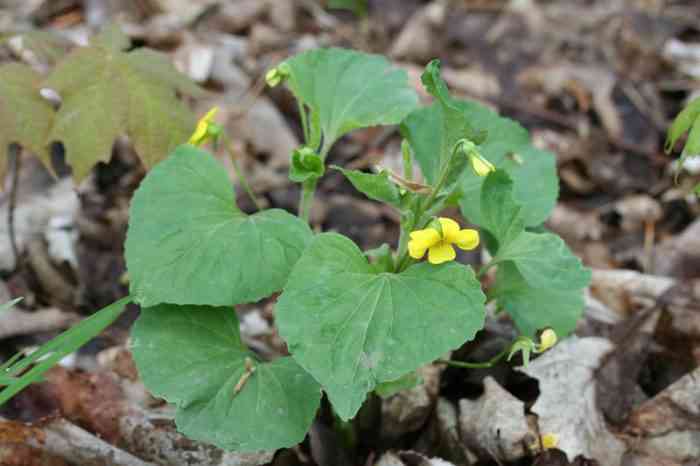
Smooth Yellow Violet are highly desirable in a woodland garden. It can be used as a low-maintenance ground cover, in rock gardens, along paths and on slopes. Its delightful yellow flowers attract butterflies and bees. It is native to the eastern United States and Canada’s wetlands, and also grows in the temperate regions of Europe and Asia.
The leaves are ovate-lanceolate in shape, 1 to 3 inches long by 0.4 to 1 inch wide, and spotted on top with brownish hairs. The flowers are yellowish green or yellow violet petals about 2 inches across that bloom from spring to summer and are borne singly or sometimes clustered on a stalk up to 2 feet tall. Each flower has six stamens and three pistils that grow in the centre of the flower head.
Quick Growing Guide
Botanical Name: Viola pensylvanica
Also Called: Downy Yellow Violet, Hairy Violet and Yellow Violet
En français: Violette pubescente
Colour:
Blooms:
Sun / Shade:
Water: Medium
Pollinators:
Care:
Caring for Smooth Yellow Violet
Viola pensylvanica, also known as yellow violet, is a perennial that grows in full sun to partial shade. This plant tolerates various soils but is happiest in rich, moist, sandy soils, which, perforce, are normally well drained. Ensure the plant is in a moist location or water it to keep it moist. It is a self-seeding plant. Or, propagate it by dividing root clumps in the fall. It is easy to grow and normally free of garden pests and diseases.
The flowers and leaves are edible.
Companion plant suggestions include trilliums.
Comments

Gardening guidance for your area—and your garden
Join our newsletter for timely gardening guidance tailored to your area. Looking for a better value? Upgrade your newsletter for personalized plant-care guidance based on the plants growing in your garden.
Leave a Reply
You must be logged in to post a comment.