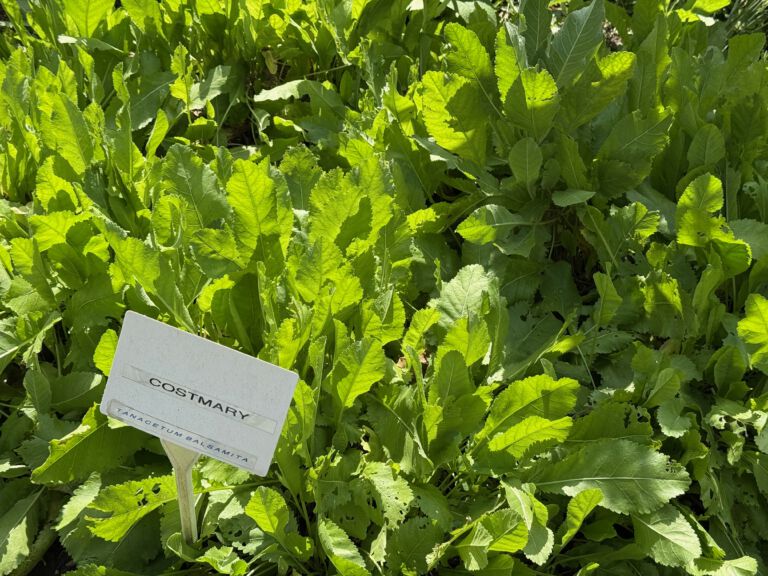
Costmary

Costmary

Tanacetum balsamita

Culinary HerbPerennialFull SunAugust and September bloom

Costmary (Tanacetum balsamita) is an aromatic herbaceous perennial with upright, clumping growth and yellow flowers in August and September. It suits full sun or partial shade, a broad range of soil textures, and dry to moist but well-drained conditions. Hardy in the approved range of Canadian-relevant Zones 4–8, it dies back in cold winters and…

Also known as: costmary, Alecost, Balsam weed, Tanacetum balsamita

Plant at a glance

Plant typeCulinary Herb
LifecyclePerennial
Hardiness4–8
LightFull Sun and Partial Shade
SoilDry, Moist, Well Drained, Sandy, Loamy, and Clay
Mature height30–80 cm
BloomsAugust and September
Flower colourYellow
WaterModerate
Care levelEasy

What this plant is like

Costmary, also called Alecost or balsam weed, is a perennial herb in the Tanacetum genus. It forms upright, bushy clumps about 30–80 cm tall. Its aromatic foliage gives it interest as a fragrant foliage plant, culinary herb, and historical medicinal or household herb. Small yellow flowers appear in late summer, generally August and September. The plant is native to Eurasia and has been introduced elsewhere, including North America.

Where it grows best

Grow costmary in full sun or partial shade, although it may flower less well with insufficient sun. It tolerates sandy, loamy, or clay soils and a pH from 5.0 to 7.6, provided the soil drains well. Conditions may range from dry to moist, but waterlogged or poorly drained soil should be avoided. Keep soil moderately moist, allowing the surface to dry slightly between waterings. Costmary is listed here for hardiness Zones 4–8, making it a hardy perennial for many Canadian gardens. Outside that range, containers can provide shelter during severe cold or excessive heat.

Garden and wildlife value

Use costmary in herb gardens, fragrant plantings, or informal clumps where its aromatic foliage can be appreciated. Its flowers are yellow and late-season, but the approved information does not establish a firm pollinator value.

Everyday care

Water moderately, increasing watering during very hot, dry weather without allowing containers to stand in water. Space plants so clumps can become bushy without overcrowding. Costmary is considered easy to grow and tolerates a wide range of soil textures and pH conditions when drainage is adequate.

What to do through the season

In cold regions, expect the top growth to die back to the ground. Remove dead stems and allow new shoots to emerge in spring. Trim or cut back stems to maintain shape, reduce overcrowding, and help prevent legginess; cutting back after flowering is supported. Divide crowded rhizomatous clumps to renew them or manage their spread.

Problems and symptoms

Costmary can spread by rhizomes and may become invasive or difficult to manage if allowed to expand unchecked. Poorly drained or waterlogged soil can cause problems. Shade may reduce flowering, while very dry conditions can require additional watering.

Corrective and preventive care

Plant in well-drained soil and avoid sites that remain soggy. Give the plant adequate sun where flowering is important. Monitor the edges of clumps and divide or trim them when they become crowded. During hot, dry weather, water more often while still preventing standing water. In cold regions, remove dead top growth after dieback and wait for spring regrowth.

Before you plant

Choose a site with full sun or partial shade and reliable drainage. Allow room for clumping growth, but plan to manage rhizomatous spread. Costmary is perennial and hardy in Zones 4–8 in this profile; gardeners outside that range can consider a container that can be moved to shelter. Propagation is supported by rhizome division and seed, with division useful for renewing established clumps.

Garden and landscape value

  • tolerant of a wide soil texture and pH range
  • hardy herbaceous perennial in cold climates
  • aromatic foliage with historical culinary and medicinal uses
  • Culinary Herb
  • Fragrant Foliage
  • Medicinal Or Historical Herb

Where it grows naturally

  • Eurasia (introduced elsewhere, including North America)

Pruning and deadheading

For costmary, clip or prune to keep plants compact and leafy, and cut back after flowering if you want to remove spent stems and encourage fresh foliage growth. Post-bloom cutting is the best-supported timing; in practice, the trigger is when stems are leggy or flowering has finished.

  • Best timing: During active growth as needed; cut back after flowering.
  • Decision cue: Plants become leggy or overgrown
  • Decision cue: The gardener wants more foliage rather than seed set
  • Pruning approach: clipping
  • Pruning approach: pruning
  • Pruning approach: light clipping
  • Caution: Do not generalize this guidance to unrelated Tanacetum species or cultivars with different flowering/woodiness.
  • Caution: Shade may reduce flowering, so deadheading decisions should be based on whether the goal is leaf harvest versus bloom display.
  • Known limitation: The captured sources support general clipping, post-flowering cutting, and foliage maintenance, but they do not provide a highly specific deadheading protocol or any pruning-group distinction beyond this herbaceous perennial’s growth habit.

Propagation

The most defensible public guidance is to propagate costmary by division of clumps/rhizomes, with root or stem cuttings also supported by authoritative horticultural sources. Seed is documented as possible, but public guidance should treat it as a less reliable option unless local sourcing and germination conditions are also documented.

  • Best timing: Division in spring or fall; semi-hardwood stem cuttings in summer; seed supported but less reliable.
  • Decision cue: A mature clump is crowded or needs renewal
  • Decision cue: The gardener wants to multiply a known plant clone
  • Decision cue: Seeds or cuttings are available from a healthy parent plant
  • division: spring or fall; also cited as early spring or autumn. Supported by extension and horticultural sources as a practical way to multiply mature clumps.
  • root cutting: not specified in captured authoritative sources. Listed by NCSU as a propagation method.
  • stem cutting: summer for semi-hardwood cuttings. Listed by NCSU; RHS specifies semi-hardwood cuttings.
  • seed: not specified in captured authoritative sources. Listed by NCSU and RHS, but other sources describe seed as difficult or not worth relying on.
  • Caution: Seed is supported as a method, but one captured source says costmary is not worth growing from seed and other sources describe division as the practical strategy; prioritize division or cuttings in public guidance.
  • Caution: Do not claim exact sowing temperatures or stratification without a source-grounded citation.
  • Caution: Do not generalize cuttings timing across all climates beyond the captured summer or general seasonal windows.
  • Known limitation: The captured sources do not provide enough consistent, source-grounded detail for a complete seed-starting protocol or for precise rooting instructions for cuttings. Timing differs by method, and only the summer semi-hardwood-cutting window is directly explicit in the captured sources.

Personalize for your garden

Your garden conditions

Tell us a little about your garden to see how this plant fits your zone, light and growing conditions. No account is required.

These garden conditions stay in this browser for Gardening Calendar. Sign in to keep your garden information with your account.

How this plant fits your garden

  • August is included in this profile’s recorded flowering months. Actual timing can vary with local conditions.

This plant can be found at

Sources used for this profile

Plant Definition last reviewed: August 17, 2026.