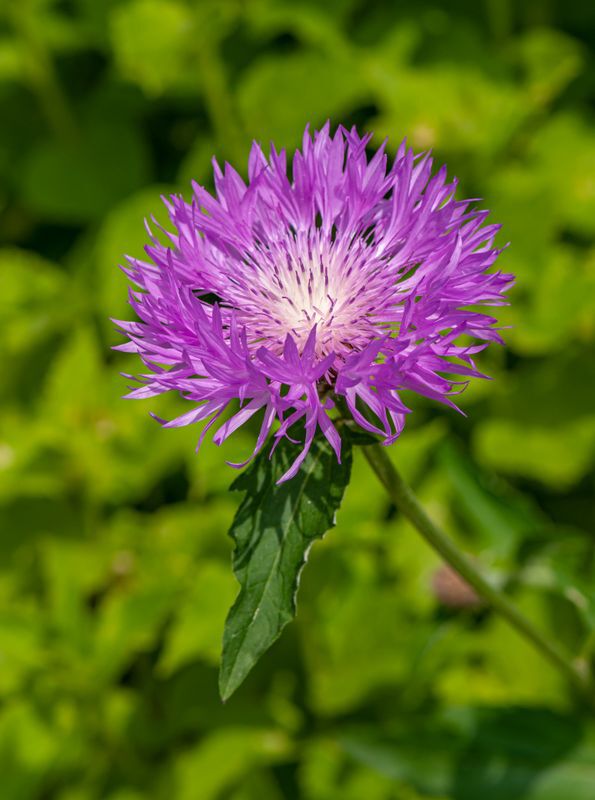
Persian cornflower

Persian cornflower

Centaurea dealbata

Herbaceous PerennialPerennialFull SunMay and June bloomPollinator / wildlife value

Persian cornflower (Centaurea dealbata) is a cold-hardy, clump-forming perennial for full sun and well-drained soil. It produces pink to lavender flowers with white centres from late spring into summer and supports bees and butterflies. Give it reliable moisture during prolonged dry spells, but avoid saturated soil, especially through winter.

Also known as: Persian cornflower, perennial cornflower, Centaurea dealbata, Psephellus dealbatus

Plant at a glance

Plant typeHerbaceous Perennial
LifecyclePerennial
Hardiness3–8
LightFull Sun
SoilModerately Moist To Moderately Dry, Well Drained, Loam, Sandy Loam, and Gritty
Mature height45–60 cm
Mature width45–75 cm
BloomsMay, June, and July
Flower colourPink, Lavender, and White Center
Wildlife valueBees, Butterflies, and Pollinators
WaterModerate
Care levelEasy

What this plant is like

Persian cornflower is an herbaceous perennial native to the Caucasus region and northern Iran. It forms a clump about 45–60 cm tall and 45–75 cm wide. Pink or lavender, thistle-like flowers with white centres appear mainly from May through July. The plant dies back to its crown in winter and regrows in spring. It is hardy in Canadian conditions corresponding to zones 3–8. Stems may flop if the plant receives less than full sun or is not supported.

Where it grows best

Choose a full-sun site with moist to moderately dry, well-drained soil. Loam, sandy loam and gritty soils are suitable, including relatively poor soils, provided water drains freely. A pH of approximately 6.8–8 is supported, with neutral to alkaline conditions suitable. Avoid wet, poorly drained or waterlogged ground. In areas with very wet climates, a slightly raised or sloping site can reduce winter moisture around the roots. The plant prefers cool summer climates and may perform less well where summers are hot.

Garden and wildlife value

Use Persian cornflower in perennial borders, cottage gardens, wildlife gardens, meadow-style plantings and cut-flower gardens. Its long bloom period and showy flowers add colour from late spring into summer. The flowers attract bees and butterflies, giving the plant value as a pollinator-friendly garden perennial. It is also listed as deer resistant. Plants may self-seed, so remove spent flowers if limiting spread is important.

Everyday care

Grow in moist but well-drained soil. Established plants usually need watering only during prolonged dry summer spells; soak deeply, then allow the soil surface to dry slightly between waterings. Avoid constant saturation and winter waterlogging. The care level is generally easy. In exposed or less-than-ideal sites, staking can help keep stems upright.

What to do through the season

In spring, watch for new growth from the crown and divide congested clumps if vigour has declined. During flowering, deadhead or lightly trim spent stems to encourage side shoots and extend blooming. After the main flowering period, cut back the clump to tidy growth and encourage fresh foliage. Division can be carried out in spring or autumn, when plants are not in active growth; water divisions well afterward.

Problems and symptoms

The main concern is excess moisture, especially cold, saturated winter soil, which the roots dislike and may cause plant loss. Prolonged summer dryness can also reduce performance. Stems may flop without full sun or staking. Self-seeding may occur, particularly where spent flowers are left in place. Hot summer conditions may lead to weaker performance than in cooler climates.

Corrective and preventive care

Prevent winter losses by planting in well-drained soil and avoiding low, saturated sites; use a slightly raised or sloping position where winter wet is a concern. During extended summer drought, water deeply while allowing slight surface drying between waterings. If stems flop, provide support and check that the plant receives full sun. Deadhead to reduce self-seeding and encourage further flowering. Cut back after the main bloom, and divide declining or congested clumps in spring or autumn.

Before you plant

Confirm that the site receives full sun and drains well in every season. Allow approximately 45–75 cm of space for the mature clump. This perennial suits gardens in zones 3–8, but cool-summer conditions may produce better performance than hot summer sites. Plan for pink or lavender flowers with white centres from May through July, and decide whether you want its pollinator value, cut flowers and informal habit or prefer to limit possible self-seeding through regular deadheading.

Garden and landscape value

  • Cold Hardy
  • Long Bloom Period
  • Pollinator Friendly
  • Tolerant Of Poor Soils
  • Deer Resistant
  • Perennial Borders
  • Cottage Gardens
  • Wildlife Gardens

Where it grows naturally

  • Caucasus region and northern Iran

Pruning and deadheading

For Persian cornflower, deadhead individual spent flower heads through the main bloom period to prolong flowering, then cut back the flowering stems more strongly after the main flush to refresh foliage; divide congested clumps in early spring or early autumn when plants are not flowering.

  • Best timing: Deadhead regularly through late spring and early summer as blooms fade. Shear or cut back after the main flush of flowering, typically in early to mid-summer depending on local climate. Lift and divide clumps for rejuvenation in early spring as new growth emerges or in early autumn after flowering has finished.
  • Decision cue: When most blooms on a stem have faded, cut or pinch off the spent flower heads (deadheading) to maintain appearance and encourage further flowering.
  • Decision cue: After the main flush of bloom in late spring to early summer, if the clump looks tired, leggy, or is beginning to flop, shear or cut stems back to a low leafy framework to stimulate fresh growth.
  • Decision cue: When flowering performance declines over several seasons, or the clump becomes congested in the center, plan to lift and divide in early spring or early autumn as suggested for division timing.
  • Pruning approach: post-flowering_shear
  • Pruning approach: removal_of_dead_or_diseased_stems
  • Pruning approach: deadheading_individual_flowers
  • Pruning approach: shearing_or_cutback_after_main_flush
  • Pruning approach: maintenance_cutback_of_senescent_stems
  • Caution: Avoid cutting back hard in late autumn in very cold regions; leaving some top growth until spring can help protect the crown over winter, a common recommendation for hardy herbaceous perennials though not stated specifically for this species.
  • Caution: Do not allow divisions to dry out after cutting back and lifting; replant promptly and water in well to reduce transplant shock, as advised for perennial division generally.
  • Known limitation: Sources give qualitative pruning guidance (deadhead, cut back after flowering, divide in spring or autumn) but do not provide precise regional calendars or detailed pruning heights for Centaurea dealbata, so the guidance remains somewhat generalized within those boundaries.

Propagation

Propagate Persian cornflower either by sowing seed following cool-temperate perennial seed protocols or by lifting and dividing established clumps in early spring or early autumn when plants are not flowering.

  • Best timing: Use seed in late winter to spring for indoor sowing or in spring for outdoor sowing once frost risk has passed; divide established clumps in early spring as new growth starts or in early autumn after flowering when weather is cool and moisture is reliable.
  • Decision cue: Use seed propagation when establishing new plantings or increasing plant numbers economically, particularly for the species rather than named cultivars.
  • Decision cue: Choose division when clumps have become large or congested, flowering has declined, or when you wish to clone a particular form with desirable characteristics.
  • Decision cue: Time division for periods when the plant is not in active flowering and conditions are cool and moist (early spring or early autumn).
  • seed_indoors: Sow indoors in late winter to spring (approximately 6–8 weeks before the last expected frost), or in early autumn for overwintering under protection, following timings such as February to May or September to November in cool-temperate climates.. Sow seeds in trays or pots filled with seed-starting mix; cover with about 1 cm of mix, as centaureas require darkness to germinate, and keep at 16–22 °C until germination, which typically occurs in 3–4 weeks. Transplant outdoors once seedlings are sturdy and risk of frost has passed.
  • seed_outdoors: Direct-sow outdoors in spring after soil has warmed and the danger of hard frost has passed, when daytime temperatures are consistently mild.. Sow in prepared beds with average, well-drained soil; cover lightly to about 1 cm depth, keep soil evenly moist until germination, then thin seedlings to the desired spacing (around 60 cm) to avoid crowding.
  • division: Divide in early spring as new growth begins, or in early autumn after flowering has finished, avoiding periods of active flowering or extreme heat.. Lift established clumps, shake off excess soil, and split into several healthy pieces, discarding old or weak centers. Replant divisions promptly at the same depth and water well until re-established. Division is particularly useful for maintaining the characteristics of named forms.
  • Caution: Named cultivars should be propagated vegetatively by division rather than seed to maintain flower colour and plant habit, as recommended for perennial Centaurea.
  • Caution: When raising plants from seed, be aware that germination can be slow (often several weeks) and uneven; maintain consistent moisture but avoid waterlogging, as seed-starting guides advise.
  • Caution: Division should be carried out when the soil is workable and not waterlogged, and freshly divided clumps must be watered in well to establish.
  • Known limitation: While seed sowing conditions and division timing are clearly described in Seedaholic and other references, species-specific details such as exact outdoor sowing dates for different Canadian regions are not provided, so timing is given in relative seasonal terms rather than fixed months.

Personalize for your garden

Your garden conditions

Tell us a little about your garden to see how this plant fits your zone, light and growing conditions. No account is required.

These garden conditions stay in this browser for Gardening Calendar. Sign in to keep your garden information with your account.

How this plant fits your garden

Enter your conditions above to see matches, cautions, and seasonal guidance.

Sources used for this profile

Plant Definition last reviewed: August 16, 2026.