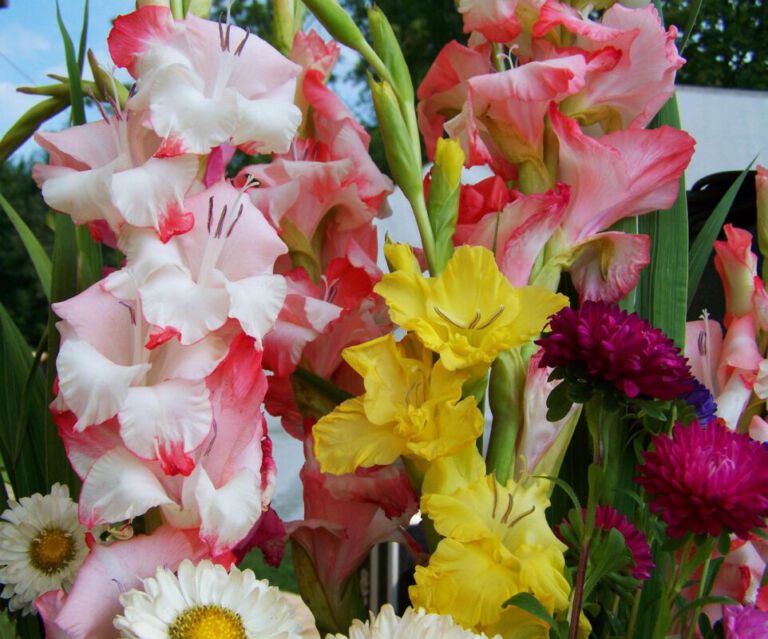
Gladiolus

Gladiolus

Gladiolus spp.

Bulb Corm Or TuberTender PerennialFull SunJune and July bloom

Gladiolus (Gladiolus spp.), also called gladioli, glads or sword lily, is a frost-sensitive tender perennial grown from corms. It produces upright summer flower spikes in colours ranging from red, pink and white to yellow, orange, purple and bicolour forms. Plant corms after frost, provide full sun and drainage, and lift them for winter in colder…

Also known as: gladiolus, gladioli, glads, sword lily

Plant at a glance

Plant typeBulb Corm Or Tuber
LifecycleTender Perennial
Hardiness7–11
LightFull Sun
SoilMoist Not Soggy, Well Drained, Loam, Sandy Loam, Light Soil, and Fertile Garden Soil
BloomsJune, July, August, and September
Flower colourRed, Pink, White, Yellow, Orange, Purple, Salmon, Scarlet, Bicolour, Striped, and Blotched
WaterArray

What this plant is like

Gladiolus is a bulb, corm or tuber plant that forms upright spikes from corms. It flowers in summer, with approved flowering months from June through September. Cultivars offer broad colour diversity, including red, pink, white, yellow, orange, purple, salmon, scarlet, striped, blotched and bicolour flowers. Its main strengths are showy blooms, strong cut-flower value and successive flowering when plantings are staggered.

Where it grows best

Choose full sun and fertile, well-drained soil that stays evenly moist without becoming soggy. Loam, sandy loam, light soil and fertile garden soil are suitable; a soil pH of 6.5–7 is supported. Avoid heavy clay, poorly drained or waterlogged soil because wet conditions can lead to corm rot. Taller varieties may need staking in windy sites.

Garden and wildlife value

Gladiolus is well suited to cut-flower gardens, beds, borders, mass plantings, exhibition flowers and containers. Staggered planting can extend the bloom period, while the wide range of cultivars provides considerable choice in flower colour and form. The supplied sources do not provide sufficiently strong evidence to describe a specific wildlife or pollinator benefit.

Everyday care

Water regularly during active growth, aiming for about 25 mm per week including rain. Increase watering during hot, dry periods, while maintaining good drainage. Mulch 5–10 cm to conserve moisture and suppress weeds. Fertilize lightly at planting and again midseason. For cut flowers, harvest spikes when the lowest florets show colour, leaving several leaves attached to nourish the corm.

What to do through the season

Plant corms in spring after the danger of frost has passed. Plant 10–15 cm deep and space them 10–15 cm apart, then mulch and stake taller plants as needed. Remove spent foliage only after it yellows. In regions colder than about USDA zone 7, lift corms after the foliage dies back; trim stems to 2–3 cm, cure the corms in a warm, airy place, and store them cool and dry for replanting the following spring.

Problems and symptoms

Frost can damage gladiolus because it is frost-sensitive and not winter-hardy in cold regions. Corm rot is a concern in wet, poorly drained or waterlogged soil. Tall spikes can be damaged by wind if they are not supported. Cold-climate plants may not survive winter outdoors without lifting and storage.

Corrective and preventive care

Wait until frost danger has passed before planting. Use well-drained soil, avoid standing water, and water regularly without waterlogging the planting area. Stake tall varieties before wind causes damage. After foliage dies in cold regions, lift, cure and store corms cool and dry; replant them the next spring.

Before you plant

Confirm that the site receives full sun and drains well. Prepare fertile soil, preferably loam or sandy loam, and check that its pH is approximately 6.5–7. Plan for regular watering of about 25 mm per week during growth. In regions colder than about USDA zone 7, make room for lifting, curing and storing corms over winter.

Ecological and wildlife value

Gladiolus has strong ornamental and cut-flower value in Canadian gardens, but the captured sources do not support a stronger ecological-landscape role such as wildlife planting.

  • Primary Landscape Role: Primarily an ornamental and cut-flower plant rather than a native-species restoration or habitat-species choice.
  • Landscape Strengths: Best used where showy vertical spikes and sequential bloom are desired, especially in beds and for cutting.
  • Wildlife Value Evidence: No strong Canadian evidence was captured for specific wildlife or pollinator benefits; avoid making that claim without additional local sources.
  • Canada: In Canada, gladiolus should be treated as an ornamental with high display and cut-flower value rather than as a plant selected for ecological or wildlife-function claims.

Seasonal actions

Seasonal care centers on spring planting after frost, steady summer watering, light feeding, post-bloom foliage retention, and autumn lifting for winter storage where freezing is a risk.

  • Planting Window: Plant corms in spring only after frost danger has passed.
  • Overwintering Action: In colder climates, dig corms after dieback, cure them, and store cool and dry for spring replanting.
  • In Season Care: During active growth, provide deep weekly watering in dry weather and light feeding rather than heavy fertilizer use.
  • End Of Season Cleanup: Remove spent flower spikes as needed, but leave foliage until it yellows so the corm can replenish.
  • Overwinter — Prevent winter loss of corms in climates where gladiolus is not hardy.. Timing: After foliage dies back in autumn and before the first hard frost or prolonged freezing.. When to act: First Hard Frost Approaches, Foliage Has Died Back, and Site Is Exposed To Winter Freezing. How: After foliage dies back, dig corms, trim tops, cure in a warm airy place, and store cool and dry until spring.. Caution: Lift corms before hard freezing if grown where winter cold is too severe; do not rely on outdoor winter survival in colder Canadian regions.. Regional note: In Canada, overwintering in the ground is only supported where local winter conditions are reliably mild enough for gladiolus; sources support lifting and dry storage where frost or freezing risk is present, but do not provide province-specific hardiness limits..
  • Plant — Establish corms at the start of the growing season.. Timing: Spring, after the danger of frost has passed.. When to act: Soil Is Workable, Frost Risk Has Passed, and Site Has Full Sun And Drainage. How: Set healthy corms in full sun, well-drained soil at the recommended depth and spacing, then water in.. Caution: Do not plant into cold, wet soil or before frost danger has passed.. Regional note: Canadian guidance is timing-based rather than province-based in the captured sources: plant after frost danger passes in spring; sources do not support a province-by-province planting calendar..
  • Cut Back — Allow the corm to store energy for the next season.. Timing: After flowering for spent spikes; end of season after foliage yellows or dies back.. When to act: Spikes Are Finished Flowering, Foliage Has Yellowed, and Season Is Ending. How: Remove spent spikes as needed, then cut foliage back only after it turns yellow or dies down.. Caution: Do not cut foliage immediately after bloom; leaves must remain until they yellow so the corm can recharge.. Regional note: Canadian timing is the same biologically, but cooler seasons may bring earlier end-of-season dieback; the sources do not support a province-specific cut-back schedule..
  • Canada: Canadian gardeners should schedule spring planting after frost danger and plan to lift corms for winter storage wherever local winters are below the plant's outdoor tolerance.

Garden and landscape value

  • showy flowers
  • good cut-flower value
  • successive bloom with staggered planting
  • large cultivar diversity
  • cut flowers
  • border plantings
  • beds
  • mass planting

Pruning and deadheading

Deadhead or harvest flower spikes when the lowest florets begin to show color or open, leaving enough foliage on the plant to support corm development. After flowering is finished, allow foliage to yellow before cutting it back; in colder climates, lift corms only after top growth dies down and then cure and store them dry.

  • Best timing: Harvest/deadhead at first color in the lowest florets; remove foliage only after yellowing; lift corms after dieback in cold regions.
  • Decision cue: When individual blooms fade/spent flowers appear
  • Decision cue: When foliage has yellowed at season end
  • Decision cue: When plants are grown for cut flowers and spikes are ready to harvest
  • Pruning approach: deadhead spent spikes
  • Pruning approach: lift corms for storage
  • Pruning approach: cut flower spikes / deadhead spent spikes
  • Pruning approach: lift corms for overwintering
  • Caution: Do not remove too much foliage too early; several leaves must remain to feed the corm.
  • Caution: In cold climates, foliage can be removed only after it yellows and corms are lifted after dieback.
  • Caution: For cut-flower harvest, timing depends on intended use and can substitute for deadheading in many plantings.
  • Known limitation: Sources support harvest/deadheading timing for cut flowers and post-bloom cleanup, but do not provide a special pruning system beyond spike removal and end-of-season foliage management.

Propagation

Propagate gladiolus primarily by planting healthy corms and separating/replanting cormels produced at the base of the parent corm. Seed propagation exists but is mainly for breeding or experimental work, and tissue culture is an advanced technical method rather than routine garden guidance.

  • Best timing: Spring planting for corms; post-dieback lifting and cormel recovery for offsets; seed and tissue culture are supported but not fully timed in the captured public sources.
  • Decision cue: Need to multiply planting stock from corms or cormels
  • Decision cue: Desire to save offset cormels after the season
  • Decision cue: Interest in breeding or advanced lab propagation
  • Decision cue: Need for a public answer about how gladiolus is usually propagated
  • plant corms: Spring after last frost. Use firm, disease-free corms and plant in spring after frost danger has passed.
  • separate and replant cormels: After foliage dies back and corms are lifted; replant in spring. Harvest cormels from mature plants after the season and store them dry until replanting.
  • seed propagation: Not sufficiently standardized in captured sources. Supported in technical literature but not well developed in the captured public sources.
  • tissue culture: Laboratory/experimental timing only. Advanced laboratory method documented in review literature.
  • Caution: Do not rely on unsourced methods such as division of true bulbs; gladiolus propagates from corms and cormels, not bulbs.
  • Caution: Seed propagation is possible but slower and more variable than corm or cormel propagation.
  • Caution: Tissue culture is technical and not a routine public Learn Hub answer unless specifically asked about advanced propagation.
  • Known limitation: The captured sources do not provide a single, fully standardized public protocol for seed timing or detailed cormel handling, so public guidance should remain high level unless more source evidence is added.

Personalize for your garden

Your garden conditions

Tell us a little about your garden to see how this plant fits your zone, light and growing conditions. No account is required.

These garden conditions stay in this browser for Gardening Calendar. Sign in to keep your garden information with your account.

How this plant fits your garden

  • August is included in this profile’s recorded flowering months. Actual timing can vary with local conditions.

Sources used for this profile

Plant Definition last reviewed: August 11, 2026.