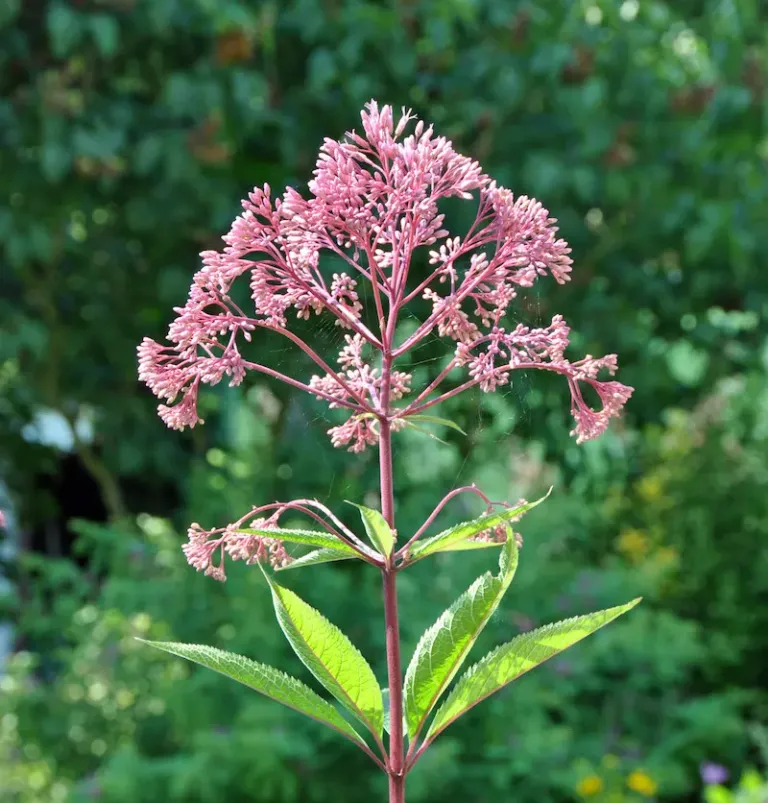
Joe-Pye weed

Joe-Pye weed

Eutrochium maculatum

Herbaceous PerennialPerennialFull SunJuly and August bloomPollinator / wildlife value

Joe-Pye weed is a tall, clump-forming native perennial for consistently moist to wet ground. Its showy purplish to dusky-pink flower clusters appear from July into October and provide strong late-season value for bees, butterflies, skippers and moths. It suits rain gardens, wet meadows, pond edges and stream banks.

Plant at a glance

Plant typeHerbaceous Perennial
LifecyclePerennial
Hardiness4–8
LightFull Sun and Partial Shade
SoilMoist, Wet, Well Drained, Poorly Drained, Fertile, Humusy, and Calcareous
Mature height120–220 cm
Mature width90–120 cm
BloomsJuly, August, September, and October
Flower colourPurplish and Dusky Pink
Wildlife valueBees, Butterflies, Skippers, and Moths
WaterMedium To Wet

What this plant is like

Eutrochium maculatum forms an upright clump with a strong vertical presence. Its flower display extends from midsummer into autumn, with the Canadian flowering period broadly described as late summer to early fall in the documented Atlantic, Ontario and Quebec range. Allow room for a large perennial that may reach about 2 m or more.

Where it grows best

Choose a site in full sun or partial shade with moist to wet soil. Suitable locations include wet meadows, marsh-like areas, pond edges, stream banks and rain gardens. Soil may be well drained or poorly drained, but it should not dry out. Fertile, humusy or calcareous soil is suitable.

Garden and wildlife value

This North American native is a strong choice for pollinator plantings and moisture-tolerant native gardens. Its late-season flower clusters support bees, butterflies, skippers and moths. Use it as a tall structural plant in a wet meadow, rain garden or pond-edge composition.

Everyday care

Keep the soil from drying out, especially while the plant is becoming established and during dry weather. Mulch may help conserve moisture. Routine fertilizer has not been established as necessary. Its approved maintenance level is low when planted in a suitably moist location.

Keep the root zone moist during establishment and dry weather. Mulch may conserve moisture. Routine fertilizer is not established as necessary.

Corrective and preventive care

The main supported preventive measure is maintaining consistently moist soil. If foliage symptoms appear, inspect the affected growth and check whether the planting is drying out or has poor ventilation. No specific pesticide treatment is supported by the approved information.

Before you plant

Confirm that the site can remain consistently moist to wet; this plant is not a good choice for ground that regularly dries out. Plan for its height and spread, and place it where its upright form will not shade or crowd smaller plants. Consider companions such as Culver’s root, Gray’s sedge, cinnamon fern, royal fern or queen-of-the-prairie where their light and moisture needs match.

Problems and symptoms

Possible concern: Unidentified foliage problemWhat to watch for: Visible leaf or stem damage, distortion, or discoloration.

Check first

  • Inspect leaves and stems for visible chewing, distortion, lesions, or abnormal discoloration.

What to do

  • Maintain the consistently moist soil conditions documented for this plant.
  • No pesticide recommendation is made because a consequential species-specific disease was not established by the reviewed authoritative sources.

When to get help

Escalate for diagnostic identification if symptoms spread rapidly, affect most foliage, or persist after correction of site stress.

Garden and landscape value

  • Supports many pollinators
  • Showy late-season flower clusters
  • Suitable for moist to wet sites
  • wet meadow
  • rain garden
  • pond edge
  • stream-bank planting
  • pollinator garden

Where it grows naturally

  • Newfoundland and Labrador
  • New Brunswick
  • Nova Scotia
  • Ontario
  • Prince Edward Island
  • Quebec
  • eastern and central North America

Plants that grow well with this one

  • Culver's root (Similar growing conditions): Shares Joe-Pye weed’s preference for moist to wet soil and full sun to partial shade, making it a practical structural companion for a moist meadow or rain-garden planting.
  • Gray's sedge (Similar growing conditions): Tolerates average to wet soil and partial shade to full shade, so it can occupy the lower, wetter or shadier layer around Joe-Pye weed.
  • Cinnamon fern (Similar growing conditions): Prefers moist, organic, well-drained soil and partial to full shade, providing a compatible foliage layer where Joe-Pye weed receives filtered shade.
  • Royal fern (Similar growing conditions): Tolerates moist to wet soil and partial to full shade, making it suitable beside Joe-Pye weed at a pond edge or in a wetter, shaded section of the planting.
  • Queen-of-the-prairie (Native plant community association): Appears with Joe-Pye weed in a recognized native-plant list for moist to average soils and can reinforce a tall, moisture-tolerant meadow composition; allow adequate space for both large perennials.

Pruning and deadheading

For routine maintenance, cut old stems to ground level in late winter. Deadheading is optional and may be used to remove spent flower heads or limit self-seeding; no stronger deadheading claim is included because the authoritative sources located primarily document seasonal cutback rather than bloom-extension effects.

  • Best timing: Late winter is the conservative primary window for cutting back; deadheading is optional after flowers have finished.
  • Decision cue: Cut back when the previous season’s stems have finished and late winter or early spring maintenance is appropriate.
  • Decision cue: Deadhead only when reducing self-seeding or removing spent flower heads is a desired garden objective.
  • seasonal cutback: Late winter; RHS also documents late autumn.. Cut previous-season stems to ground level.
  • deadheading: After flower heads are spent; exact species-specific timing was not documented by the strongest sources located.. Remove spent flower heads only when limiting self-seeding or improving appearance is desired.
  • Pruning approach: late-winter cutback
  • Pruning approach: optional deadheading
  • Caution: Removing spent flowers is optional; retain some heads if winter structure or seed is desired.
  • Caution: Avoid allowing the consistently moist soil requirement to lapse during active growth.
  • Known limitation: The reviewed evidence does not establish a precise deadheading method, a bloom-extension period, or a cultivar-independent response to formative pruning.

Propagation

Propagate established plants by division in spring or fall, or by seed in spring. Replant divisions at a suitable moist site consistent with the approved plant profile.

  • Best timing: Division: spring or fall. Seed: spring.
  • Decision cue: Use division when an established clump is available and additional plants are wanted.
  • Decision cue: Use seed when propagation from mature seed is acceptable and cultivar uniformity is not required.
  • division: Spring or fall.. Lift and separate an established clump, then replant divisions.
  • seed: Spring.. Sow seed using a suitable propagation medium and maintain appropriate moisture; detailed species-specific protocol was not verified.
  • Caution: Divide only established plants and replant divisions promptly so roots do not dry out.
  • Caution: The reviewed sources support seed or division but do not provide enough species-specific detail to prescribe seed treatment or sowing depth.
  • Known limitation: The reviewed evidence does not establish division size, number of buds per division, seed stratification requirements, germination timing, or a reliable cultivar-specific propagation protocol.

Read more on GardeningCalendar

Personalize for your garden

Your garden conditions

Tell us a little about your garden to see how this plant fits your zone, light and growing conditions. No account is required.

These garden conditions stay in this browser for Gardening Calendar. Sign in to keep your garden information with your account.

How this plant fits your garden

Enter your conditions above to see matches, cautions, and seasonal guidance.

References

Plant Definition last reviewed: October 10, 2026.