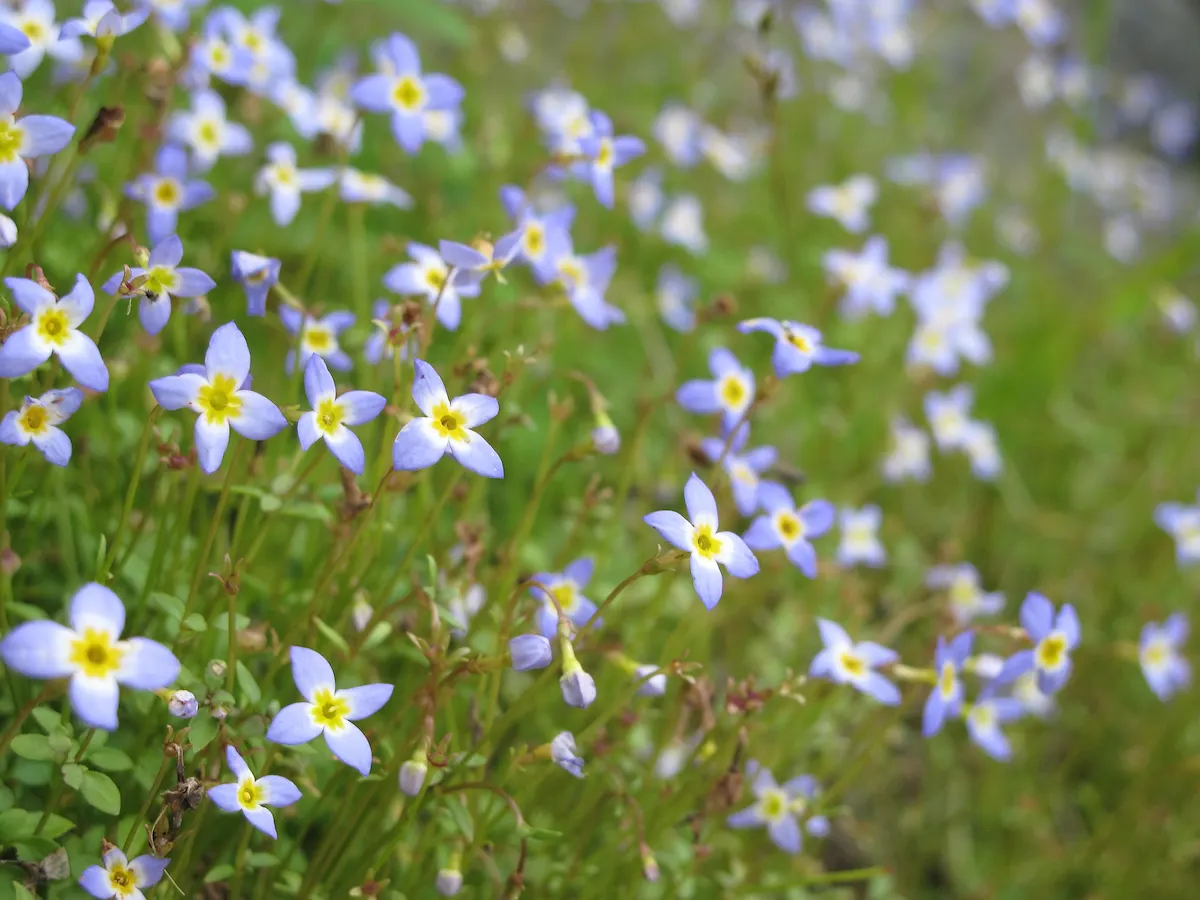
Azure bluets

Azure bluets

Houstonia caerulea

GroundcoverPerennialFull Sun To Part SunSpring bloom

Azure bluets, also called Quaker ladies, is a low perennial groundcover native to parts of eastern Canada. It suits moist, free-draining sites from full sun to part sun, producing pale-blue spring flowers. Its low maintenance needs and probable pollinator value make it useful for small native plantings.

Also known as: Quaker ladies

Plant at a glance

Plant typeGroundcover
LifecyclePerennial
Hardiness3b–7b
LightFull Sun To Part Sun
SoilMoist and Free Draining
Mature height8–15 cm
Mature width8–15 cm
BloomsSpring
Flower colourPale Blue
WaterRegular

What this plant is like

Houstonia caerulea forms a small, low-growing perennial groundcover with pale-blue spring flowers. It is native in New Brunswick, Nova Scotia, Prince Edward Island, Quebec and Ontario, but is excluded from the approved Newfoundland and Labrador range. Its maintenance level is low, and it offers no privacy screening.

Where it grows best

Choose a moist site with free-draining soil and exposure ranging from full sun to part sun. Its approved Canadian hardiness range is Zones 3b to 7b, so suitability varies across Canada. Avoid locations where soil stays persistently saturated.

Garden and wildlife value

Azure bluets supports a native-planting goal and has probable pollinator value. Deer are reported resistant. Approved low-competition design companions include bloodroot, heartleafs, wild columbine, shooting-star and yellow stargrass.

Everyday care

Keep moisture suitable for the plant, particularly when conditions cause stress, while maintaining drainage. The plant is considered low maintenance. Pet safety is unknown for both dogs and cats, so do not assume the foliage or flowers are safe to eat despite the approved record listing leaves and flowers as edible parts.

What to do through the season

In spring, enjoy the pale-blue flowering display and check that the planting area is not remaining saturated. During the growing season, watch overall plant condition and maintain appropriate moisture. No approved pruning or propagation instructions are available for this profile.

Corrective and preventive care

Good drainage is the main approved precaution. If plants decline, first consider whether the site is staying waterlogged or whether the plants are under moisture-related stress. Seek local diagnosis when symptoms spread, recur or cause substantial plant loss; avoid broad treatments without confirmed identification.

Before you plant

Confirm that your location falls within the approved Canadian hardiness range and, if native status matters, note that the approved native range covers New Brunswick, Nova Scotia, Prince Edward Island, Quebec and Ontario, not Newfoundland and Labrador. Select a moist but free-draining site and plan companions that will not overwhelm this small groundcover.

Problems and symptoms

Possible concern: Root or crown rotWhat to watch for: Persistent wilt, yellowing, or crown collapse despite adequate moisture.

Check first

  • Inspect leaves and crown for unusual lesions, discoloration, or collapse.

What to do

  • Use free-draining soil and avoid chronic saturation.
  • Remove and discard clearly collapsed or severely affected plant material; avoid moving wet soil between plants.

When to get help

Escalate for diagnosis if symptoms spread, recur despite improved drainage and sanitation, or cause crown collapse or substantial plant loss.

Possible concern: Sap-feeding insectsWhat to watch for: Clusters of small insects, distorted new growth, or fine webbing.

Check first

  • Examine leaf surfaces and undersides for visible insects or webbing.

What to do

  • Maintain suitable moisture and avoid unnecessary plant stress.
  • Rinse small infestations from foliage with water and remove badly affected leaves if practical; avoid broad treatment without confirmed identification.

When to get help

Seek local diagnosis if insects are numerous, symptoms rapidly worsen, or plant vigor declines significantly.

Where it grows naturally

  • New Brunswick Native
  • Ontario Native
  • Newfoundland and Labrador Excluded
  • Prince Edward Island Native
  • Quebec Native
  • Nova Scotia Native

Plants that grow well with this one

  • Bloodroot (Visual or design companion): Mt. Cuba Center identifies bloodroot as a low-competition companion, reducing concern that it will overwhelm this small groundcover.
  • Heartleafs (Visual or design companion): Listed as a low-competition companion suitable for the same woodland-style planting context.
  • Wild columbine (Visual or design companion): Listed by Mt. Cuba Center among attractive, low-competition companions.
  • Shooting-star (Visual or design companion): Listed as a low-competition companion for Quaker ladies.
  • Yellow stargrass (Visual or design companion): Listed by Mt. Cuba Center as an attractive low-competition companion.

Propagation

For seed, collect capsules when mature, sow fresh outdoors or provide cold, moist stratification before spring sowing; press seed onto the surface or cover only very lightly and keep evenly moist. For division, separate an established clump and replant divisions promptly in suitable moist, free-draining soil.

  • Best timing: Seed: when ripe or after cold, moist stratification for spring sowing. Division: during a non-flowering period.
  • Decision cue: Use seed when producing plants from collected or purchased seed is preferred.
  • Decision cue: Use division for an established clump when vegetative increase is preferred.
  • seed: When ripe in late season, or spring after stratification. Fresh outdoor sowing or cold, moist stratification; surface sow and keep moist. Seedlings commonly flower in the second year.
  • division: When plants are not under active flowering stress; exact Canadian timing not established by retrieved evidence. Divide an established clump and replant promptly; avoid allowing roots to dry.
  • Caution: Keep the fine seed on the surface or sow shallowly; do not bury it deeply.
  • Caution: Maintain the medium moist but not waterlogged during germination and establishment.
  • Known limitation: Exact division technique and the best regional timing are not fully documented in the retrieved Canadian sources. The four-month stratification period comes from a Native Plant Network protocol and may vary with seed lot and handling.

Read more on GardeningCalendar

Personalize for your garden

Your garden conditions

Tell us a little about your garden to see how this plant fits your zone, light and growing conditions. No account is required.

These garden conditions stay in this browser for Gardening Calendar. Sign in to keep your garden information with your account.

How this plant fits your garden

Enter your conditions above to see matches, cautions, and seasonal guidance.

References

Plant Definition last reviewed: September 29, 2026.