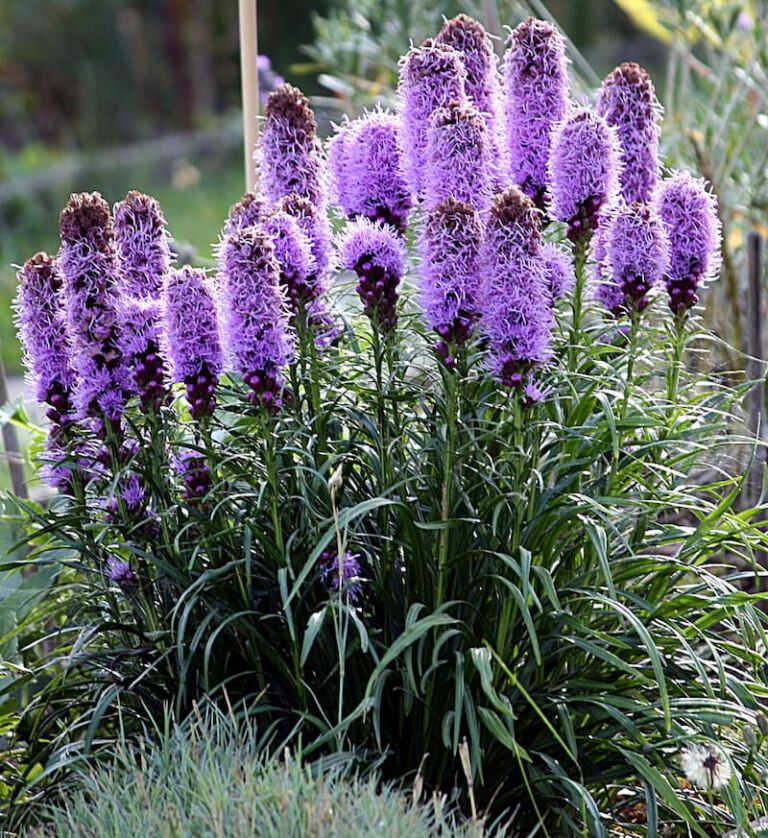
Dense blazing star

Dense blazing star

Liatris spicata

Herbaceous PerennialPerennialFull SunJuly and August bloomPollinator / wildlife value

Dense blazing star (Liatris spicata) is an upright, clump-forming herbaceous perennial grown from underground corms. It produces grass-like foliage in spring and tall purple, violet or white flower spikes from July through September. Give it full sun, well-drained soil and regular moisture while it establishes; established plants tolerate drought, but not winter waterlogging.

Also known as: dense blazing star, blazing star, gayfeather, dense gayfeather

Plant at a glance

Plant typeHerbaceous Perennial
LifecyclePerennial
Hardiness3–9
LightFull Sun
SoilMoist, Average, Dry, Well Drained, Sandy, and Loamy
Mature height61–183 cm
Mature width61–61 cm
BloomsJuly, August, and September
Flower colourPurple, Violet, and White
Wildlife valueBees, Butterflies, Pollinators, Birds, and Native Wildlife
WaterWater New Plants Thoroughly; Keep Evenly Moist During Establishment; Drought Tolerant Once Established; Avoid Waterlogged Soil
Care levelModerate

What this plant is like

Dense blazing star, also called blazing star, gayfeather or spike gayfeather, forms upright clumps about 61 to 183 cm tall and about 61 cm wide. Grass-like leaves appear in spring, followed by tall flower spikes in mid to late summer. Flowers may be purple, violet or white. The plant dies back to ground level in autumn and remains dormant through winter. It is hardy in Canadian planting conditions corresponding to zones 3 through 9.

Where it grows best

Choose a full-sun site with well-drained, sandy or loamy soil. Average, moist or dry conditions can suit the plant, provided drainage is good. Keep soil evenly moist while new plants or corms establish; established plants are drought-tolerant and usually need water only during extended hot, dry spells. Avoid wet, waterlogged or heavy clay soil, especially in winter, because excess moisture can cause corm rot. In southwestern Ontario, dense blazing star is conservation-sensitive and is associated with moist to wet sandy soils in open mesic tallgrass prairie habitat. This regional habitat context should not be treated as a broad national garden description.

Garden and wildlife value

The summer flower spikes provide value for bees, butterflies and other pollinators. The species also has broader native-wildlife value, including associations with birds and butterflies. Its upright form and long July-to-September flowering period suit perennial plantings where full sun and well-drained soil are available.

Everyday care

Water new plants thoroughly and maintain even moisture during establishment. Once established, water during prolonged hot, dry periods rather than on a fixed schedule. Routine pruning is minimal: remove spent flower spikes for a tidy appearance and remove damaged stems. Keep plants in place over winter; the above-ground growth naturally dies back in autumn.

What to do through the season

In spring, watch for new shoots emerging from the underground corms. Divide crowded clumps at this time by separating corms or tuberous roots, ensuring each division has at least one growing point. Summer care mainly involves establishment watering or watering during extended dry spells, plus optional removal of spent flower spikes. In autumn, expect the plant to die back to ground level and enter winter dormancy.

Problems and symptoms

The main site-related concern is excess moisture. Waterlogged or heavy clay soil, particularly during winter, can contribute to corm rot. Newly planted corms, plugs and seedlings need closer attention to moisture during establishment than established plants. Containers may dry out more quickly than plants in the ground.

Corrective and preventive care

Plant in well-drained soil and avoid sites that remain waterlogged, especially over winter. Water thoroughly during establishment, then allow the plant's established drought tolerance to reduce watering during ordinary dry periods. If clumps become crowded, divide them in early spring as new shoots emerge, separating corms or tuberous roots and retaining at least one growing point on each division. Remove damaged stems and spent spikes as needed.

Before you plant

Confirm that the site receives full sun and drains well. Plan for a mature height of roughly 61 to 183 cm and a width of about 61 cm. Make sure you can provide even moisture during establishment without creating persistently wet soil. In southwestern Ontario, check the conservation and habitat context before planting, as the species is conservation-sensitive there and tied to remnant tallgrass prairie habitats.

Ecological and wildlife value

Dense blazing star has clear ecological landscape value as a native, pollinator-supporting species for sunny, well-drained plantings, especially in prairie- or meadow-like designs.

  • Native Habitat: Dense blazing star is an eastern North American native associated with moist prairie, meadow, and marsh-edge habitats.
  • Pollinator Value: The flower spikes provide nectar and habitat value for bees and butterflies.
  • Landscape Form: Its upright clumps and summer flower spikes make it useful as a vertical accent in sunny perennial plantings.
  • Wildlife Value Scope: Supported wildlife value is strongest for pollinators; broader wildlife benefits are less directly documented in the provided sources.
  • Canada: In Canada, dense blazing star should be treated as an eastern North American native-plant species with strongest ecological fit in habitats that resemble moist prairie, meadow, or marsh-edge conditions; the supplied sources do not support a province-by-province Canadian natural range map, so avoid assuming broad Canadian nativity beyond eastern-region context.

Seasonal actions

Seasonal care centers on spring planting or division, first-season watering, limited later watering, and simple post-bloom cleanup.

  • Establishment Watering: Water regularly during the first growing season to help plants establish a strong root system.
  • Established Plant Watering: After establishment, water only during extended hot, dry weather rather than on a fixed schedule.
  • Planting Site Conditions: Place new plants in full sun with well-drained soil and avoid sites that stay too moist.
  • Post Bloom Cleanup: Remove spent flower spikes after bloom if a tidier appearance is desired.
  • Clump Division: Divide crowded clumps in early spring as new shoots emerge.
  • Winter Drainage Risk: Keep soil well drained year-round and avoid winter-wet sites to reduce corm rot risk.
  • Water — Support establishment and drought recovery while minimizing rot risk.. Timing: Spring through the first growing season; later only during prolonged heat and drought.. When to act: Newly Planted Plants Or Corms Are Establishing. and Extended Hot, Dry Weather Occurs After Establishment.. How: Water regularly during the first growing season, then reduce to occasional watering during extended hot, dry spells once established.. Caution: Avoid keeping soil wet in winter or in poorly drained clay; excess moisture can contribute to corm rot..
  • Deadhead — Keep flowering stems neat after bloom.. Timing: After the flowering spikes fade in late summer.. When to act: Flower Spikes Have Finished Blooming.. How: Remove spent flower spikes after flowering.. Caution: This is a tidy-up task, not a major pruning regime..
  • Divide — Maintain vigor and prevent overcrowding.. Timing: Early spring as new shoots emerge.. When to act: An Established Clump Is Crowded. and New Growth Has Just Begun In Spring.. How: Dig clumps in early spring as new shoots emerge and separate the corms or tuberous roots into pieces with at least one growing point each.. Caution: Divide only established crowded clumps; each division needs a growing point..
  • Plant — Establish plants in the correct site conditions before the growing season.. Timing: Plant in spring when soil can be worked and new plants can root before summer heat.. When to act: You Are Selecting A Site Or Installing New Plants. and The Site Has Full Sun And Good Drainage.. How: Set plants in full sun with well-drained soil; spacing of about 12-15 inches is reported in extension guidance.. Caution: Do not rely on wet or poorly drained sites; winter wetness is the main hazard reported for the species..

Pruning and deadheading

Deadhead or remove spent flower spikes after bloom for a tidier plant. For crowded established clumps, dig and divide in early spring just as new leaves emerge. Routine pruning beyond this is minimal.

  • Best timing: After flowering for deadheading; early spring for division as new leaves emerge.
  • Decision cue: Flowering has finished and spikes are spent.
  • Decision cue: In early spring, new leaves or shoots are just emerging and clumps are crowded.
  • spring_division: early spring, just as leaves emerge. Dig and divide large clumps when leaves are just emerging.
  • Caution: Avoid presenting spring division as generic pruning for all species; for this species it is a clump-maintenance action after emergence, not a flowering-wood cutback issue.
  • Caution: Do not claim a hard pruning regime; sources support only minimal pruning and deadheading/spent-spike removal.
  • Known limitation: The captured sources do not establish a detailed pruning calendar beyond post-bloom cleanup and spring division, and they do not support a more aggressive cutback schedule.

Personalize for your garden

Your garden conditions

Tell us a little about your garden to see how this plant fits your zone, light and growing conditions. No account is required.

These garden conditions stay in this browser for Gardening Calendar. Sign in to keep your garden information with your account.

How this plant fits your garden

  • August is included in this profile’s recorded flowering months. Actual timing can vary with local conditions.

Related Gardening Calendar articles

Sources used for this profile

Plant Definition last reviewed: August 12, 2026.